The Exact Question Sequence That Turns Open House Visitors Into Clients
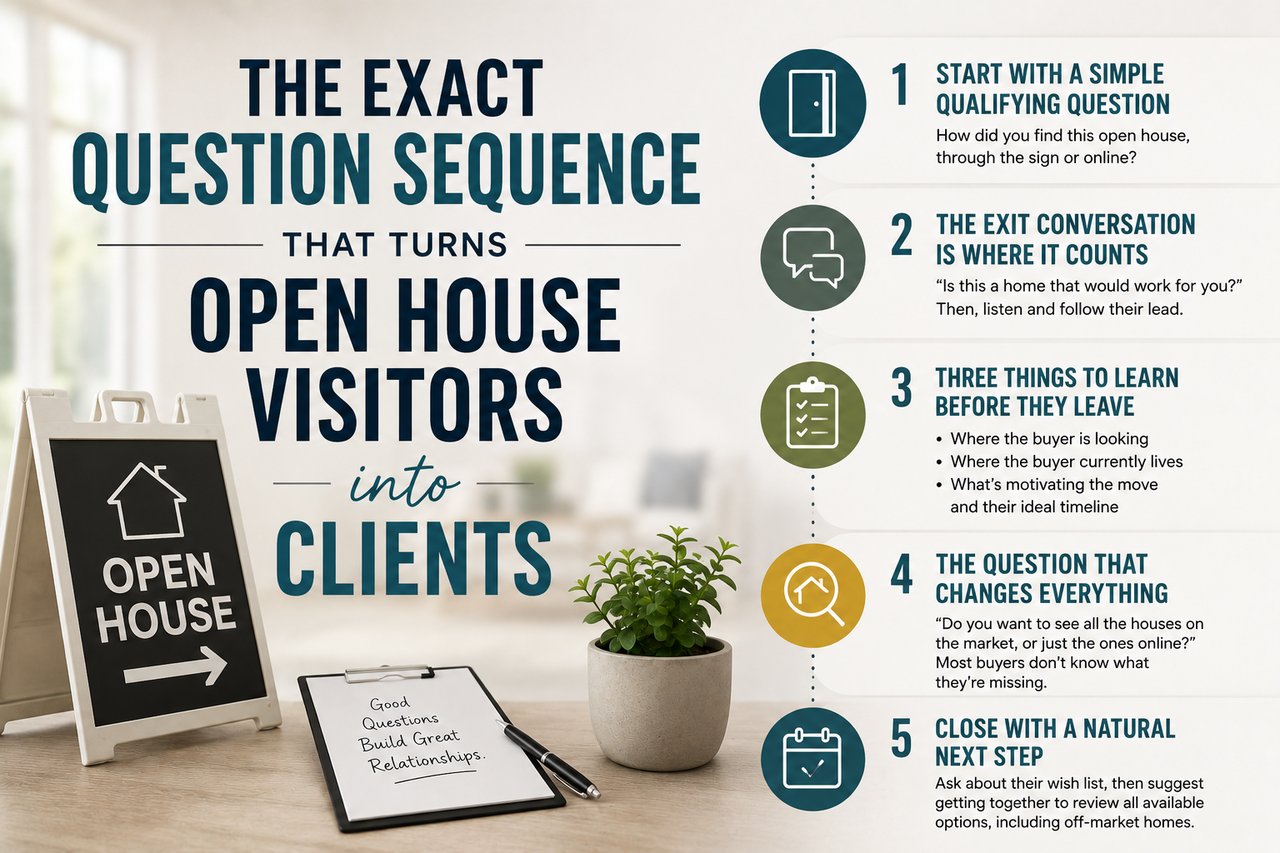
Most agents leave an open house without a sale and without a single new client relationship to show for it. According to Meredith Fogle, founder and team lead at The List Realty, that's rarely a matter of talent. It's a matter of using a structured conversation sequence, word for word, at the right moments.
The moment someone walks through the door, ask how they found the open house: through a sign or online. The answer helps frame the rest of the conversation. Visitors who found the listing through a sign may already live nearby or be driving through with high interest, while online visitors may be earlier in their search or already working with an agent.
After check-in, give visitors a short, specific detail or two about the home, something they might not notice on their own, and let them know you'll check back in once they've finished touring. This sets an expectation for a follow-up conversation without feeling forced.
Once a visitor finishes touring, the conversation that follows matters more than anything said at the door. The key first question is deceptively simple: "Is this a home that would work for you?" Not whether they liked it, not whether they could see themselves living there. That exact phrasing, followed by silence while they think it through, does the work.
If the answer is a clear yes or shows strong buying signals, the conversation shifts toward next steps on that specific property. If the answer is no or uncertain, that's the cue to ask a follow-up question rather than push further on the current home.
By the end of the conversation, an agent should know:
Where the buyer is looking
Where the buyer currently lives
What's motivating the move, including their ideal timeline
Simple, single questions work best here. Asking what's prompting a move, then following up with their ideal timeline, tends to surface useful detail without feeling like an interrogation. It's important to avoid stacking multiple questions at once or digging too deep into reasons a home doesn't fit, since the goal at this stage is gathering information and building rapport, not closing on this particular property.
Before moving further, it's also necessary to confirm the visitor isn't already under a signed agreement with another agent. A direct, simple question handles this cleanly and keeps the conversation within appropriate professional boundaries.
Once it's confirmed a visitor isn't represented, one question tends to shift the entire conversation: "Do you want to see all the houses on the market, or just the ones online?"
Most buyers search exclusively through major listing sites without realizing how much inventory never appears there. In this market, a meaningful share of homes sell without ever hitting the open market. Pointing that out, and offering access to that additional inventory, tends to reframe the entire relationship. It answers a need the visitor didn't know they had.
From there, the transition toward an actual appointment is straightforward: ask about their wish list, then suggest getting together to compare it against available inventory, including homes not yet publicly listed. It's a natural next step rather than a hard pitch.
Fogle emphasizes that this sequence takes repetition to feel natural. "You have to practice this. This does not come immediately easy to every human being," she says, describing how her team rehearses the script regularly so it comes across as a real conversation rather than something recited.
If you're building your skills as an agent and want structured training like this as part of your day-to-day work, reach out to The List Realty to learn more about what it looks like to grow your career here.
Watch: How to Convert Open House Visitors into Signed Clients
Stay up to date on the latest real estate trends.
By Meredith Fogle
By Meredith Fogle

By Meredith Fogle
By Meredith Fogle

By Meredith Fogle
By Meredith Fogle
By Meredith Fogle

By Meredith Fogle

By Meredith Fogle
You’ve got questions and we can’t wait to answer them.