The Question Most Agents Miss That Turns a Buyer Into a Seller
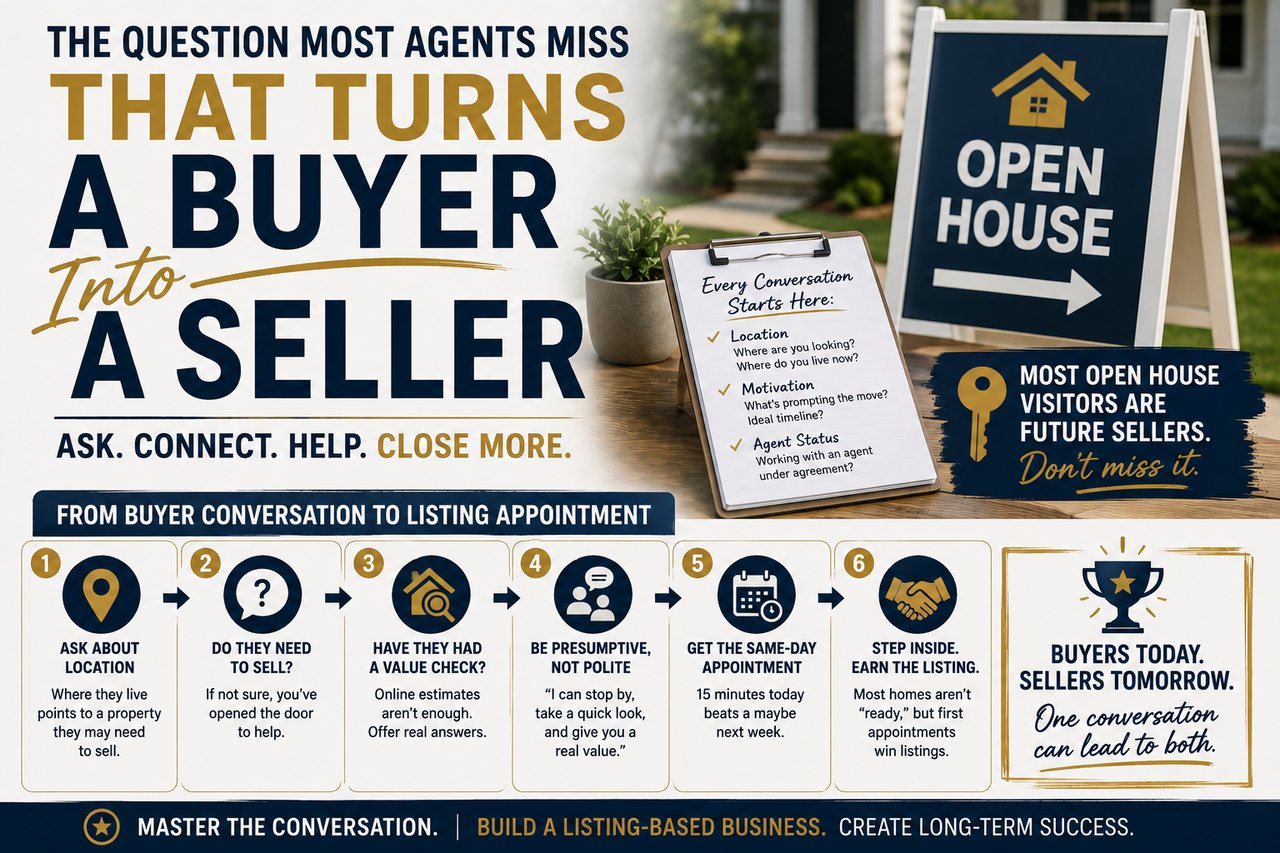
Most agents treat open houses as a buyer activity. But a meaningful share of the people walking through the door are also potential sellers, and most agents never find that out because they stop asking questions too early.
Meredith Fogle of The List Realty breaks down how to extend the LMA framework, location, motivation, and agent status, into a natural pivot toward a listing conversation, without it feeling like a hard sales pitch.
The foundation starts with three simple areas to cover in any open house conversation:
Location. Where is the buyer currently looking, and where do they live now?
Motivation. What's prompting the move, and what's their ideal timeline?
Agent status. Are they already working with a buyer's agent under a signed agreement?
Most agents ask these questions and stop there, treating "where do you live now" as simple context. But that answer points to an actual property, and in many cases, one that needs to be sold.
Once it's clear a visitor already owns a home, the natural next question is whether they need to sell it in order to buy. Some will say yes, some no, but most fall into "not sure," which opens the door to a conversation where an agent can genuinely help.
From there, a simple follow-up works well: has anyone given them an accurate sense of what their current home is worth in today's market? Many buyers will mention an online estimate, which creates a natural opening to explain that automated valuations are frequently inaccurate, and that a professional, in-person assessment gives them real numbers to work with.
How this offer gets phrased matters. Rather than asking "would you like me to" or "would it be helpful if," a more effective approach states the next step directly: "What would make sense is for me to come over, take a quick look at your house, and see what it's worth in today's market." People respond to what actually helps them, not to what an agent wants to do for them, and presumptive language moves the conversation forward more naturally than an open-ended offer does.
Not every visitor needs to sell before buying. If someone says no, a useful follow-up is asking what they plan to do with their current property, whether renting it out, keeping it in a family member's hands, or something else. Sometimes "no" really means "not yet," and a gentle clarifying question can reveal whether there's still an opportunity to help down the line.
Once a seller has indicated interest in a home value conversation, the strongest move is asking directly what they're doing right after the open house, and offering to stop by for a quick 15-minute look at the property. A common objection, that the house "isn't ready," has a simple response: houses are rarely ready the first time an agent sees them, and getting a foot across the threshold dramatically increases the odds of securing that listing.
Most agents separate buyers and sellers into two entirely different conversations. In reality, they're very often the same person. Asking the right questions in sequence, and following through with a clear next step rather than leaving things open-ended, is what turns an open house visitor into a full transaction instead of half of one.
If you're an agent looking to sharpen your open house conversion strategy, reach out to The List Realty to learn more about the frameworks we use to help agents build listing-based businesses.
Watch: How to Turn Open House Buyers Into Listing Appointments
Stay up to date on the latest real estate trends.
By Meredith
By Meredith Fogle
By Meredith Fogle
By Meredith Fogle
By Meredith Fogle
By Meredith Fogle
By Meredith Fogle
By Meredith Fogle

By Meredith Fogle
You’ve got questions and we can’t wait to answer them.