Maryland Lead Paint Law for Landlords: What Montgomery County Rental Owners Need to Know in 2026
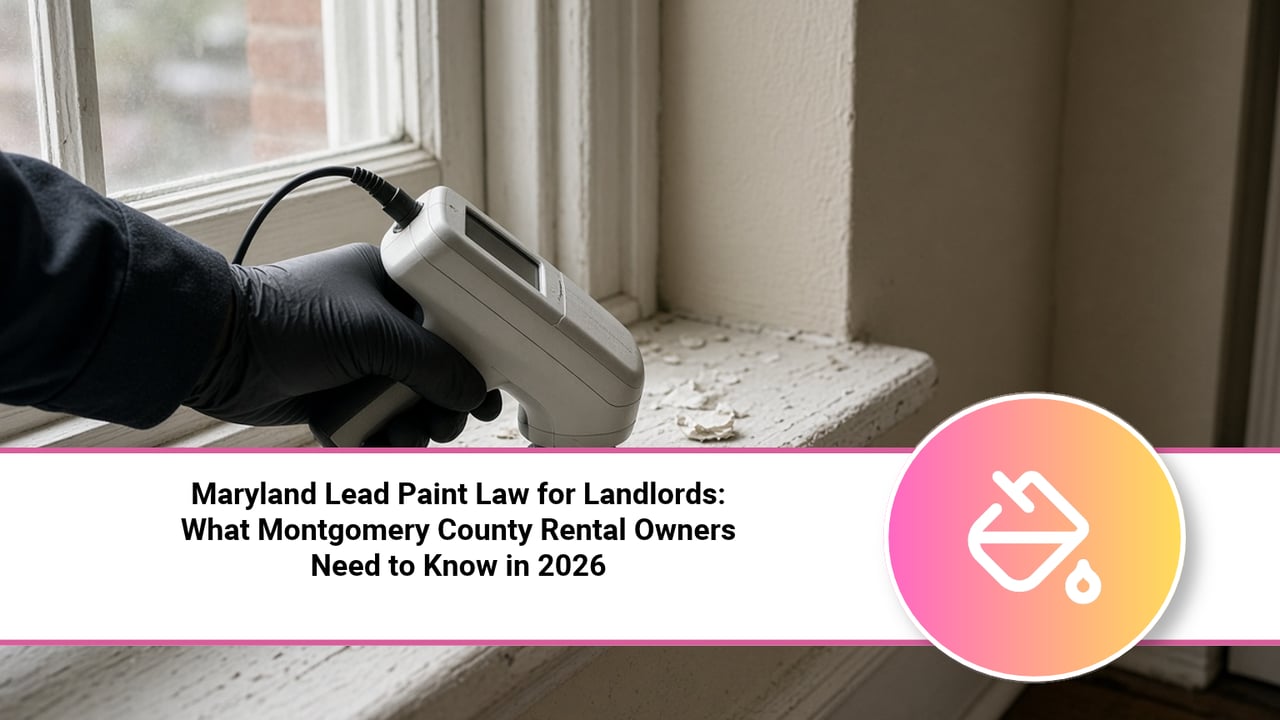
If you own a rental home, townhouse, or condo in Montgomery County that was built before 1978, Maryland's lead paint law applies to you, and it applies whether or not the property has been renovated. Many owners assume that a new kitchen, fresh paint, or new flooring takes a home out of the rules. It does not. The age of the home is what counts, and a great deal of the housing in Gaithersburg and across the county was built before that line. The good news is that staying compliant is mostly a matter of paperwork and timing, not heavy lifting, once you know what is required and when.
Start by confirming the year your property was built. If you are not certain, check your tax record, your settlement documents, or the county property database rather than guessing, especially if the date is close to 1978. A rented house counts as one unit, and a building with several rentals is counted unit by unit. There are exemptions, but they are narrow. A property certified lead free by an accredited inspector can be exempt from ongoing registration and risk reduction requirements, and a limited lead free certificate carries its own conditions, including reinspection every two years. Even a lead free property still has to follow the federal disclosure rules described below, so an exemption narrows your obligations rather than erasing them.
Every covered unit has to be registered with the Maryland Department of the Environment, and if you buy a rental, registration is due within 30 days of acquiring it. One change catches a lot of owners off guard this year. Effective January 1, 2026, the registration and renewal fee rose from $30 to $75 per unit, and the payment now covers two years, with renewals due on or before December 31 of the renewal year (Maryland OneStop, Lead Paint Rental Unit Registration). If you learned the process as a $30 annual renewal, it is worth updating your calendar. A lapsed registration tends to stay invisible until the moment you need the paperwork.
The heart of the law is what happens at every turnover. Each time one tenant moves out and a new one moves in, the property has to meet what Maryland calls the full risk reduction standard. An MDE accredited inspector checks the interior and exterior for chipping, peeling, or otherwise defective paint and then performs a dust test. If the home passes, the inspector issues a lead risk reduction certificate. If it does not, the problems have to be corrected, using accredited professionals where the law requires them, and the home has to pass before the new tenant moves in. That is why the inspection belongs on your turnover schedule from day one. Line up your inspector before the current tenant is even out, address visible paint issues early, and finish cleaning before the test, since the test is looking at dust. A scheduling delay or an avoidable failure can push back a move-in date by days or even weeks.
Your tenants also have to receive specific materials. At the start of every new tenancy, Maryland requires you to provide the state's Notice of Tenant's Rights, the EPA's lead hazard information pamphlet, and a copy of the current lead inspection certificate, and those materials have to be redistributed every two years for tenants who stay. That two-year redistribution is the step owners most often forget with a long-term tenant, so it helps to put it on your calendar the day the lease is signed and keep proof that you delivered it. Separately, federal rules for housing built before 1978 require you to disclose any known lead-based paint or hazards, provide the federal pamphlet, include the required lead warning statement in the lease, and keep records of that disclosure for three years. If your lease is an older template, this is often where gaps show up. And because these obligations attach to the property rather than to the people living there, every tenant in a pre-1978 rental gets the same disclosures and the same process.
If you ever receive written notice of defective paint in a rental, the law gives you a short window, generally 30 days, to have the hazard addressed by accredited contractors and obtain a passing certificate, which may mean relocating the tenant temporarily while the work is done. These situations are not do-it-yourself projects. Call your attorney and your property manager right away, and use MDE accredited inspectors and contractors for any lead work. For renovation work in older homes, federal rules also require EPA certified firms that follow the EPA's renovation, repair, and painting rules, so the lowest bid from a general handyman is rarely the right call.
Here in Montgomery County, lead compliance is tied directly to your rental license. The county requires a rental housing license before a property can be rented or even advertised for rent, and before issuing or renewing that license, DHCA Licensing and Registration must receive verification that a pre-1978 property complies with the state lead requirements. The county also asks owners of these properties to complete an Annual Lead Poisoning Prevention Checklist, due by March 31, with the lead certificate attached (Montgomery County DHCA, Lead Poisoning Prevention Compliance). Keep in mind that some municipalities, including Gaithersburg and Rockville, run their own rental licensing, so confirm which jurisdiction covers your address. Registering with MDE does not replace a local license, and a local license does not replace MDE registration.
The real cost of falling behind is much larger than a $75 fee. MDE can order compliance and assess civil penalties, missing paperwork can complicate your license and your legal position with a tenant, and noncompliance can be used to support a negligence claim against an owner. The owners who run into trouble are usually not the ones with the oldest homes. They are the ones who never built a simple system for registrations, certificates, and tenant materials.
"Lead compliance isn't complicated, but it is unforgiving about missing paperwork. When owners build it into every turnover and every renewal date, it simply becomes part of running a well-managed rental," says Felicia Kaminker, owner of LST Property Management.
Requirements and fees can change, so confirm current details with MDE and your licensing jurisdiction before you act. If you own a rental in Montgomery County, Gaithersburg, or the surrounding area and are not sure your lead registration, certificates, and rental license are all in order, reach out to LST Property Management for a no-pressure review of where you stand. You can watch Felicia Kaminker walk through the full checklist in our LST Property Management video Maryland Lead Paint Law for Landlords: 2026 Guide.
Stay up to date on the latest real estate trends.

By Meredith Fogle

By Meredith Fogle

By Meredith Fogle
By Meredith Fogle

By Meredith Fogle

By Meredith Fogle
By Meredith Fogle

By Meredith Fogle

By Meredith Fogle
You’ve got questions and we can’t wait to answer them.