Should You Ask a Montgomery County Seller for a Rate Buydown Instead of a Lower Price?
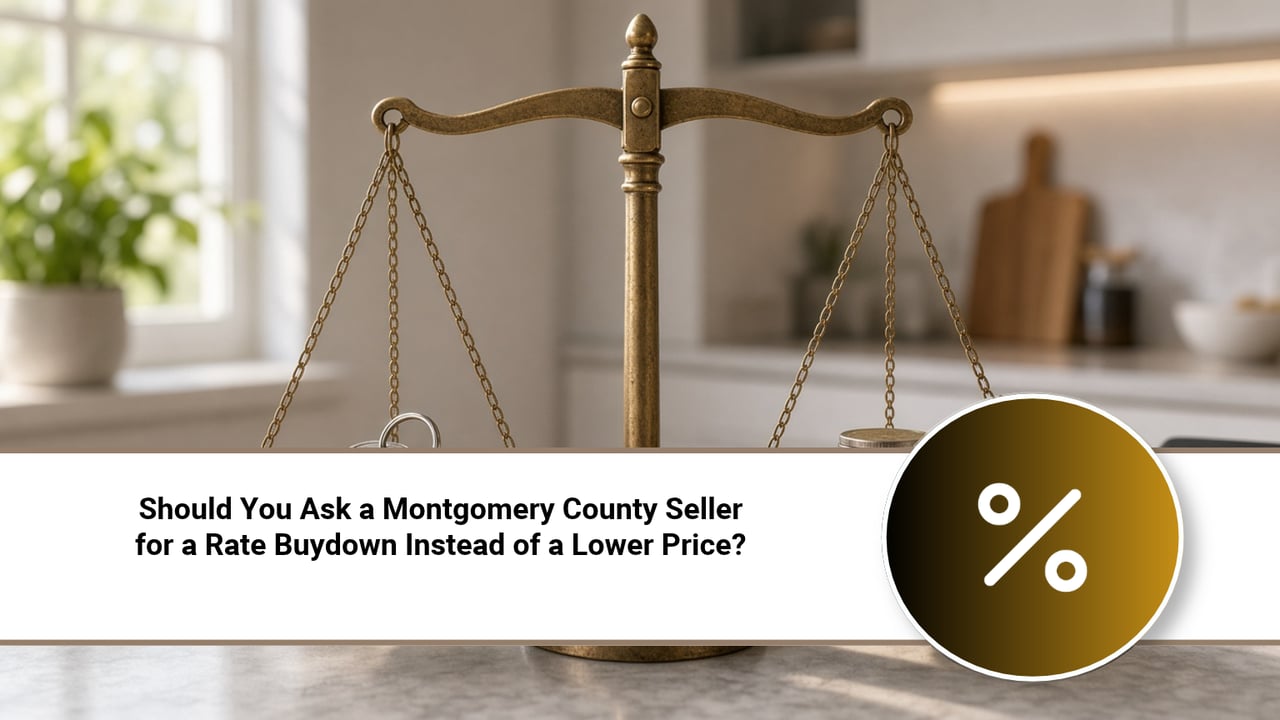
If you are ready to buy in Montgomery County this fall, the monthly payment is probably the number you watch most closely, and it may be the reason you are wondering whether to ask the seller for something other than a lower price. With rates still above 7%, more buyers are asking whether a seller credit toward a mortgage rate buydown would help them more than a price reduction. It is a smart question to ask before you write an offer, because the two can look similar on paper and work very differently in your budget.
The market gives buyers some room to have that conversation. Freddie Mac's average 30-year fixed rate was 7.24% as of October 29, 2026, down from 7.32% the week before but well above the 6.17% of a year earlier (Freddie Mac PMMS). In September, Montgomery County had 2,447 active listings, homes that sold averaged 34 days on market, and sellers received an average of 97.3% of their original list price, while the county median sold price held at $610,000, up 1.8% from a year earlier (GCAAR Montgomery County September 2026 report). Competition has not disappeared, though. Long and Foster's county report shows 28% of homes sold in September went for more than their original asking price (Long and Foster Montgomery County market report). Some sellers have room to negotiate and some do not, so the right ask depends on the home.
Here is why the question matters. A price reduction lowers your loan amount, which lowers your payment a little every month for the life of the loan. A seller credit toward a rate buydown pays your lender upfront to lower your interest rate, either permanently or for the first few years. To see the difference, take a simple illustration using the current average rate. On a $600,000 home with 10% down, a $540,000 loan at 7.24% carries a principal and interest payment of roughly $3,680 a month. A $15,000 price reduction would trim that by only about $92 a month. By comparison, a temporary 2-1 buydown, which lowers the rate by two points in the first year and one point in the second, would cost about $12,700 on the same loan and would reduce the payment by roughly $700 a month in year one and about $360 a month in year two before it returns to the full rate. Your own numbers will depend on your loan, your lender's pricing, and the rate you lock, so ask your lender for a written quote on each option.
Each approach has trade-offs. A temporary buydown gives you the most relief early on, which can help if you expect your income to grow or you want breathing room while you settle in, but the payment does rise, and lenders generally qualify you at the full note rate. A permanent buydown, paid as discount points, lowers the rate for as long as you keep the loan, though its value shrinks if you refinance or sell within a few years. A price reduction is the only option that also lowers your loan balance and your down payment, which is why it can make more sense if you plan to stay a long time or if the home seems overpriced compared with recent sales. A credit can also go toward ordinary closing costs, which reduces the cash you need at settlement, and in a community with an HOA, conventional loan rules even allow a credit to cover up to 12 months of association assessments after settlement.
There are limits to keep in mind. On a conventional loan for a home you will live in, Fannie Mae caps seller contributions at 3% of the price or appraised value when you put down less than 10%, 6% with 10% to 25% down, and 9% with more than 25% down, and the credit cannot exceed your actual closing costs, including any buydown (Fannie Mae Selling Guide, Interested Party Contributions). FHA and VA loans have their own limits, so confirm yours with your lender. Any credit also has to be supported by the appraisal, which is another reason to ground your offer in comparable sales rather than the list price alone.
So how do you decide what to ask for? Start with your plans. If you expect to stay put for many years, a lower price or a permanent buydown usually holds its value best. If you want the lowest payment right away, or you hope to refinance if rates ease, a temporary buydown may stretch your budget furthest in the years that feel tightest. Then look at the home itself. A home that has been listed for several weeks or already had a price cut often belongs to a seller who would rather offer a credit than lower the price again, while a fresh, well-priced listing may not leave room for either. Many buyers end up with a combination, such as a modest price adjustment plus a credit toward closing costs, which is often easier for a seller to accept than one larger concession.
"Buyers often focus on the price, but the payment is what you live with every month. The right ask is the one that fits how long you plan to stay and what your budget needs in the first few years," says Meredith Fogle, owner of The List Realty.
If you are getting ready to make an offer in Montgomery County, Gaithersburg, or Kentlands and Lakelands and want to know whether a price reduction, a rate buydown, or a mix of both makes the most sense for a specific home, reach out to The List Realty for a consultation. We can review the recent sales, the seller's situation, and your lender's numbers with you so you can write an offer with confidence.
Stay up to date on the latest real estate trends.

By Meredith Fogle
By Meredith Fogle
By Meredith Fogle
By Meredith Fogle
By Meredith Fogle
By Meredith Fogle
By Meredith Fogle
By Meredith Fogle
By Meredith Fogle
You’ve got questions and we can’t wait to answer them.