Why Most Agents Fail at the Hour of Power, Even When They're Consistent
Most agents treat the hour of power as pure discipline: sit down, dial, repeat. But according to Meredith Fogle of The List Realty, that mindset is exactly why so many agents struggle to get real results from prospecting, even when they're technically showing up every day.
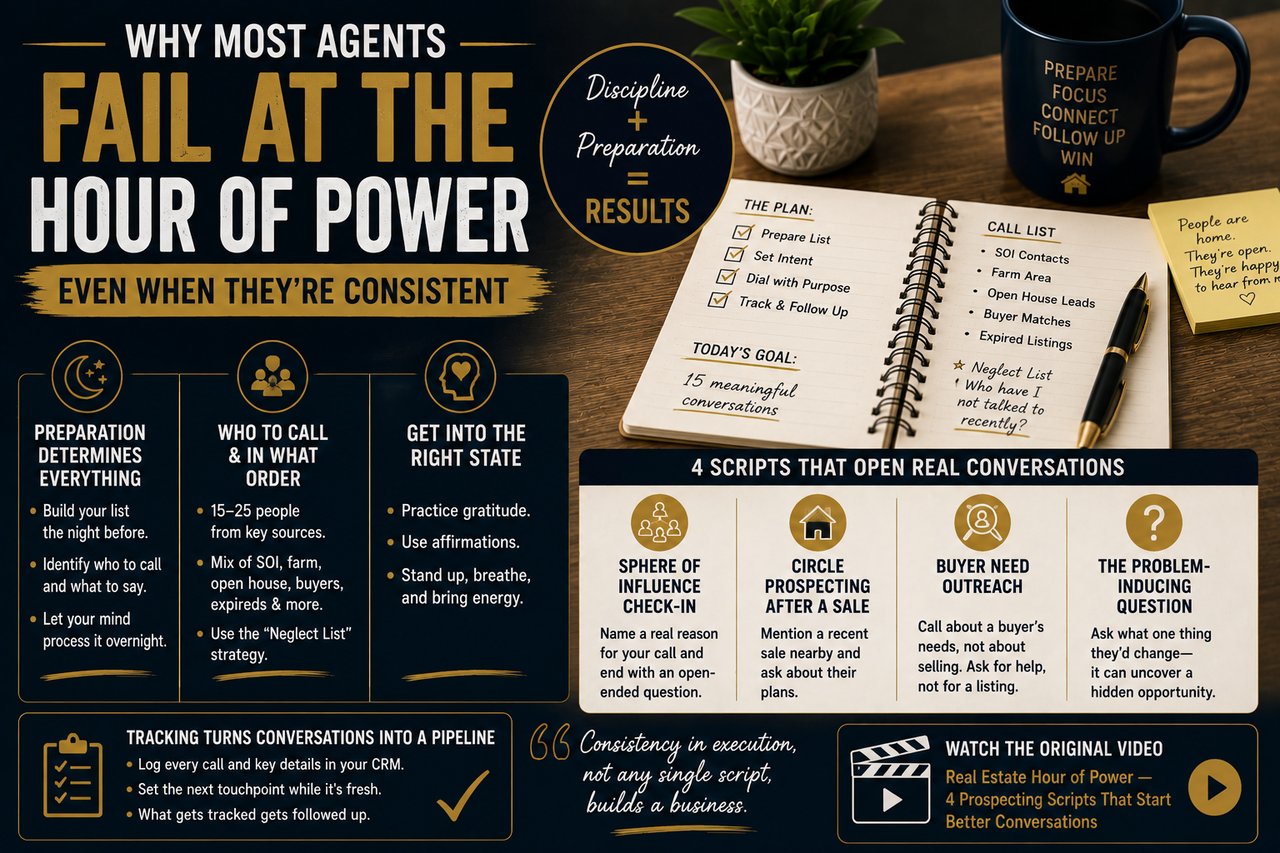
Sitting down without a plan creates immediate mental resistance. Without a prepared list and a clear sense of who to call, agents start unconsciously talking themselves out of the activity before it even begins. Preparing the night before, building the call list, identifying who to reach out to, and even outlining what to say, allows the subconscious mind to process it overnight, making the actual calling session feel far less daunting.
A solid call list should include 15 to 25 people, drawn from a mix of sources: sphere of influence contacts, geographic farm areas, past open house leads (even old ones), potential buyer matches, and expired listings. Each group offers a slightly different entry point, but all share one thing: some existing familiarity or a clear reason the call would be welcome.
One especially useful approach is what Fogle calls the "neglect list" strategy: sorting contacts by who's been reached out to least recently or least frequently. These are often the people most receptive to hearing from you, simply because it's been a while.
Energy carries through a phone call in ways that are easy to underestimate. A few grounding techniques help shift into a more effective state before calling: taking a moment to feel genuine gratitude toward a few specific people, using a simple affirmation ("People are home, they're open, they're happy to hear from me"), and even making calls standing up rather than seated, which measurably changes tone and energy.
Sphere of influence check-in. Rather than a generic "just checking in," a more effective opener names a real, timely reason for the call and ends with an open-ended question like "What questions do you have right now?"
Circle prospecting after a nearby sale. Mentioning a recent sale in someone's neighborhood, paired with a question about their own plans, taps into natural curiosity people already have when something changes close to home.
Buyer need outreach. Framing a call around a specific buyer's needs, rather than asking directly if someone wants to sell, feels less like a sales pitch and more like a request for help, something most people respond to warmly.
The problem-inducing question. For homeowners who insist they're never moving, asking what they love most about their home, then gently following up with what one thing they'd change, can surface a real consideration they hadn't previously voiced out loud. Fogle shared a personal example: after months of a longtime client insisting they'd never move, this exact question revealed that stairs had become a genuine concern. That home is now under contract, and the clients have purchased a home with a main-level primary suite.
Conversations that aren't logged in a CRM effectively don't exist for future follow-up purposes. Documenting what was discussed, and scheduling the next touchpoint, is what turns individual conversations into a real, trackable pipeline over time. Consistency in execution, not any single script, is ultimately what builds a business.
If you're looking to build more structure into your own prospecting routine, reach out to The List Realty to learn more about the coaching and systems support available to agents here.
Watch: Real Estate Hour of Power — 4 Prospecting Scripts That Start Better Conversations
Stay up to date on the latest real estate trends.
By Meredith
By Meredith Fogle

By Meredith Fogle

By Meredith Fogle

By Meredith Fogle

By Meredith Fogle

By Meredith Fogle

By Meredith Fogle

By Meredith Fogle
You’ve got questions and we can’t wait to answer them.